

Laboratory analyses
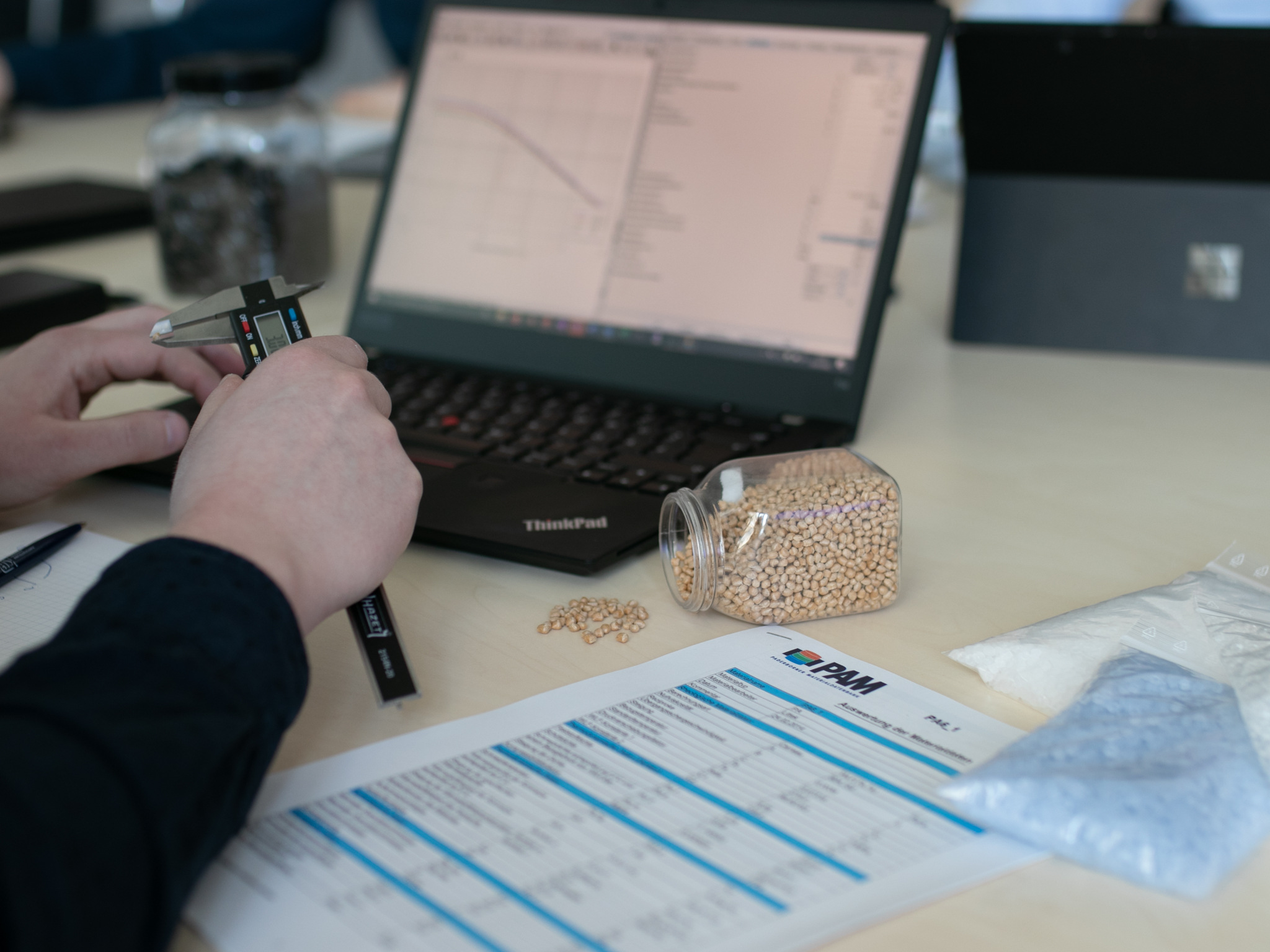
The technologically modern equipment of our test laboratories enables us to provide you with well-founded and reliable results that support you in the development and optimization of materials, products and processes, quality assurance and systematic failure and damage analysis.
The close interlocking between the material parameters determined by laboratory analysis and the software tools of Kunststofftechnik Paderborn lays the foundation for directly feasible simulation processes following the material analysis.
As a supplement to tests according to national and international standards, you benefit from customized solution options for individual questions. You will find an overview of our range of services in the detailed presentation.
Physical test methods
Density determination
- Buoyancy method (DIN EN ISO 1183)
- Determination of bulk density (DIN EN ISO 60)
- Density determination of plastic melts with high pressure capillary rheometer (pvT)
Surface properties with different probes
- DIN EN ISO 4287
- Roughness, waviness, sink marks, grooves, elevations
Sieve and wet sieve analysis
- DIN 53477
Determination of particle size distribution using the QicPic analyser
Moisture determination (CaH2 method)
Moisture determination (Karl Fischer titration)
Stress crack analysis
- for PC, PMMA, PS, ASA, ABS, SAN
Determination of the particle size distribution of carbon black particles in rubber compounds using a dispersion tester
Rheological test methods
Mass and volume melt flow rate (MFR / MVR)
- according to DIN EN ISO 1133
Spiral flow test
Viscosity determination on a high-pressure capillary rheometer
- according to DIN 53014
Determination of solution viscosity
- Material types PET, PA, PBT, PC
Viscosity determination for rubber compounds on the online extrusion rheometer
Recording a vulcameter curve / cross-linking isotherms for rubber compounds on the Rubber Process Analyser (RPA)
- DIN EN ISO 6502
Determination of dynamic parameters for rubber compounds (storage and loss modulus)
Determination of macromolecular damage (degradation of viscosity) of polymers on a shear cup
Thermal test methods
Differential Scanning Calorimetry (DSC)
- DIN EN ISO 11357
- Heat conversion, crystallinity, crystallite melting range
- glass transition temperature, oxidation stability, reaction kinetic data
- specific heat
- enthalpy
Thermomechanical analysis (TMA) (ISO 11359)
- Change in length under dynamic or static load
- Dynamic or static tensile tests
Thermogravimetric analysis (TGA)
- DIN EN ISO 11358
- Weight changes and reaction kinetic data
- at constant or increasing temperature
Determination of temperature and thermal conductivity of solids and melts
- according to DIN EN ISO 22007-1 / DIN EN 821-2
Vicat softening temperature
- DIN EN ISO 306
HDT heat deflection temperature
- DIN EN ISO 75
Burning behaviour
- DIN 75200, UL94 (V0, V1, V2, HB40, HB75, VTM0, VTM1, VTM2, 5VA, 5VB)
Residue on ignition
- DIN EN ISO 3451
Optical test methods
Component imaging using a computer tomograph
- Detection of voids, defects etc.
- Determination of fibre orientation in fibre-reinforced plastics
- Determination of porosity in foamed or additively manufactured components
Microscopic analyses (digital microscope)
- Transmitted and incident light methods
- Polarised light
- Heatable sample table
- Particle size measurement
- Image analysis
- Photo and video recordings
- Non-contact inspection of surface properties (laser microscope)
Colour measurements (Minolta colour measuring device)
- Measuring device for samples up to 20x30 mm
Gloss measurement, stress optics, refractive index determination
Reflectance and transmission curves
- DIN EN ISO 13468
- 380-780 nm
Contact angle measurement
- DIN 55660
Fibre length distribution (with high-resolution scanner)
- incl. annealing residue
Infrared spectroscopy (FTIR via ATR)
Mechanical test methods
Bending test
- DIN EN ISO 178
- Three-point and four-point loading with electrical force and deflection measurement, force-deflection diagram, incl. bending modulus up to 10kN (-80 - 250 °C)
Tensile test
- DIN EN ISO 527
- Force measuring range 0-1 kN, 0-5 kN, 0-10 kN, 0-50 kN, determination of modulus of elasticity, incl.: fine and coarse extension measuring device, electronic extension and force measurement, stress-strain diagram
- Nitrogen cooling of the temperature chamber from -80 °C to room temperature
- Heating of the temperature chamber from room temperature to +250 °C
- Long-term testing with media insert
Fatigue tests on an ElectroPuls E10000 dynamic testing system
Testing the adhesion of thermoplastic elastomers to substrates
- VDI 2019
Impact bending test
- DIN EN ISO 179 u. 180
- 0-5 J; 2.93 m Impact velocity
- 0-50 J; 3.85 m Impact velocity
Impact tensile test
- DIN EN ISO 8256
Abrasion test
- DIN 53754
Ball indentation hardness
- ISO 2039
Shore hardness (Shore A, Shore D)
- DIN ISO 7619
Determination of granulate friction coefficients
Many of our customers order this material data set from us with individual advice on the temperatures that make sense to select and receive corresponding further feedback on the quality of the results of the various measurements.
Contact

Dr.-Ing. F. Brüning
Managing Director
Kunststofftechnik Paderborn gGmbH
Technologiepark 12
D-33100 Paderborn
Tel.: +49 (0) 5251 787509-0
E-Mail: info@ktp-software.de
Dr.-Ing. F. Brüning
Managing Director
Kunststofftechnik Paderborn gGmbH
Technologiepark 12
D-33100 Paderborn
Tel.: 05251/60-3837
E-Mail: info@ktp-software.de